
Garden Gnome Plantscapes
Fine Gardening & Landscape Work
New Orleans, Louisiana • Est. 2019
State St. Ground Cover
Asiatic Jasmine is a traditional and reliable ground cover commonly seen in Uptown New Orleans, especially in the space between a sidewalk and the street. It is an evergreen vine native to Japan and Korea, but it is well suited to our Gulf Coast climate.
Asiatic Jasmine is closely related but different from the Star Jasmine which so famously perfumes the city each spring. Where Star Jasmine grows up to cover fences and poles, the Asiatic Jasmine grows horizontally to cover the ground. Asiatic Jasmine rarely flowers in our climate, although sometimes you can catch a bloom.
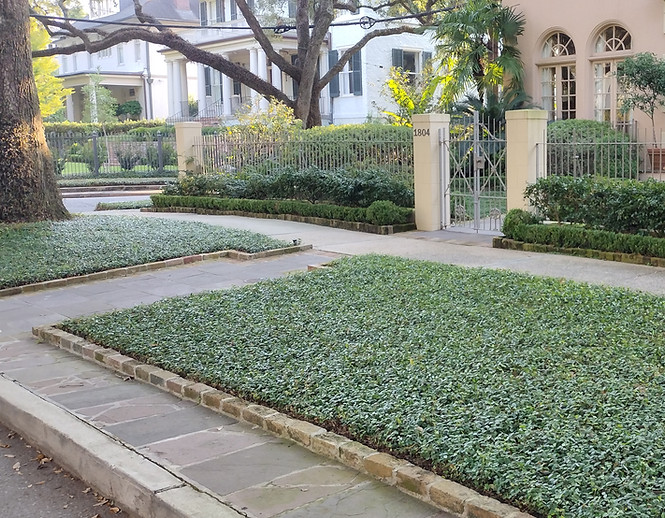
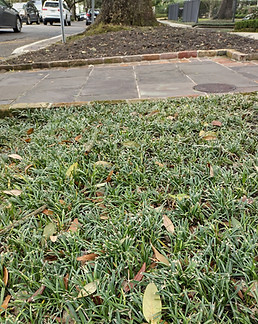
This location was previously planted with Liriope spicata which we removed by hand. Liriope spicata has white flowers, is smaller, and is super invasive with a tendency to spread underground and persist in gardens even after removal attempts. (The more common Liriope muscari has purple flowers and is larger but also more well-behaved.) The liriope was also in poor health, full of weeds, and the ground was uneven. Perhaps most importantly, it didn't match the rest of the street and the neighborhood, where almost every house has jasmine ground cover for a couple blocks in any direction.
After digging out the old liriope and weeds, we let the beds lay fallow for a couple months to monitor and remove returning weeds. We also raked compost over the area to fertilize and even out the holes and rough spots.

Asiatic jasmine is usually planted using 4-inch plugs. We measured the space, calculated the number of plugs we would need, arranged them into a grid pattern, and planted them into the settled compost. Immediately after planting, it didn't look like much: the jasmine plants were small with lots of space in between.
There's a little rhyme that applies to the growth of ground covers: "The first year it sleeps, the second year it creeps, and the third year it leaps!" This is a reminder that gardens are an exercise in patience. For the first year, the jasmine hardly grew on top, focusing its growth invisibly underground as the root systems established. During this time, we diligently kept on top of weeding as well as removing surviving liriope.
Finally, after about a year, the jasmine had settled its roots and began to grow fast. By the middle of the second summer, the vines had almost entirely interlocked and covered the space and it became necessary to begin regular trimming. Two and a half years after planting (right on schedule), the jasmine had matured and grown to match the other plantings in the neighborhood.
From one point of view, we just planted some ground cover. From another point of view, projects like this can represent historical preservation and stewardship of the visible spaces of New Orleans, helping maintain the magic of our special city.

